Showing posts with label blank fretboard. Show all posts

Monday, March 18, 2019

Ironed


Re-string adventure continues- Ibanez SIR70FD. Pickups on board are DiMarzios: Tone Zone (b)/ True Velvet (m)/ Air Norton (n).

I'm somehow thankful that Ibanez has the Iron Label range albeit my gripe with it in terms of purpose. The guitars in this range were given the alternative treatment without ending up as costly proto-customs. I was particularly drawn to this model due to its blank fretboard. That's my quirk- I have more confidence playing an unmarked fretboard. The SIR70FD is part of the pioneer Iron Label releases. The RGs at this point in time, featured EMG pickups while the S-Series were given the passive, gain friendly DiMarzios instead. 

The S-Series in this range had evolved to feature a reverse headstock & some fancy body caps but the DiMarzio & fixed bridge features stay put. I sincerely hope the Iron Label series won't go out of hand because as it is, it's a little fuzzy when it comes to being identified as a definite tier in terms of offering. Then again, this year the Axion Label became the branch-off which threatens to push the Iron Label into extinction.

Saturday, March 19, 2016

Poll: Fretboard markers

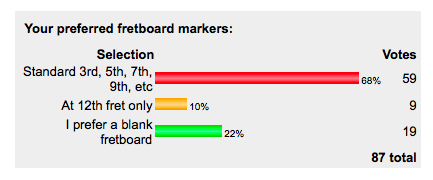
Thank you, everyone, for participating in the fretboard marker poll.


For many of us, the traditional fretboard marker placement is still our preferred navigation reference. We started with guitars bearing such a feature, we are used to these visual markings, many of our preferred brand names out there feature such references any way. It's a 'safe' reference, it works, it's the way to go.


There are some of us who prefer a half-way mark reference only. Visually, this helps us divide the neck into two particular portions, we are less confused this way. We are not entirely comfortable with a blank but this bare minimum is definitely a plus as opposed to many markings.


There is a sizeable number of players who prefer a totally blank fretboard, many citing the ease of transposing fingering patterns without a visual limitation. These people are very familiar with positions & placements, looking at what one plays is actually optional.


In any case, we have our side dots to help us navigate a blank landscape should our bearings fail us. Whatever the case may be, the human element here means we have different visual preferences. We stick to what works for us. However, my dear friends, do not let differences in features prevent us from learning how to play better. In many instances, that wee bit of struggle helps shape us into better learners; labour now, smile later. Also, do not let others dictate the features you should have in your instruments, "Hey, you WILL play better with a blank fretboard." There is no definite outcome when there are differences across individuals; what works for the rest might not work for you.

Monday, March 23, 2015

Absent guidance

When I started out, fretboard markers were crucial. The fundamental dots were my numerical markings for notes. They were there for absolute references. Subsequently, they confused me as I own both 22-fret & 24-fret guitars. The 2-fret difference is a small issue to many other players but for someone who is musically illiterate & banking on visual references, those 2 digits were make or break for me on many instances. 

Then came a time when I told myself, surely, I could do without those markers because those blind players, they adapted from day one. If they could do it with a handicap, those without such an issue could surely adapt. That was when I bought this Yamaha RGX A2, it's my initial foray into marker-less territory but it was a breeze in terms of adaptability. I guess by then, my ears were guiding my playing more than my eyes. This was the reason why I could still play while watching TV & for the record, I could pretty much play if you blindfolded me. It's no longer about looking & knowing where to place one's fingers, it's about instantly recalling the placement of that 'sound' & being one with the instrument. These days, I prefer a blank fretboard; it's the freedom to travel without being reminded where you are.

Monday, March 7, 2011

The vacant helper

I've been excessively critical when it comes to an unmarked fretboard. However, over time, if one is familiar with one's instruments, the hand moves without visual assistance. Last night, I was messing around with scales, particularly combining them to manifest some chromatic havoc, in terms of positional organization, the blank fretboard helps a lot. I'm actually thankful my LP BFG sports such a feature.