Showing posts with label P-Rails. Show all posts

Tuesday, August 6, 2024

George's Solar

George Kapa, from the band Six for Nine, is now a Solar endorser. If you don't know who he is, then you're not alone. I checked him out only after seeing this debuted at Solar's web page (GC1.6GK). Be informed that the pickups here are Seymour Duncans (not Duncan Solars): P-Rails (n) / 59 Custom (b). George is Greek, quite obviously, the colour of his national flag is on his guitar. See / hear this guitar in action: 


Pic: Solar guitars

Saturday, December 11, 2021

Selling: Pickups

Have these spare pickups to clear, have been lying around for a while with the intended use for them either changed or abandoned entirely. 
  • Gibson 500T ($130). Zebra finish, it's a T so it's a bridge model. High output with clarity, unlike the rest of the Gibson 'buckers which might sound wimpy when it come to high gain stuff. Condition: 8.5/10
  • Seymour Duncan '59 ($99). Nickel cover, single conductor, for neck position. Totally unused, protective plastic film still in tact, full wore length. For vintage outings & some immaculate cleans. Condition: 10/10
  • Seymour Duncan Phat Cat ($70). This is a single coil, P90-esque pickup but in a standard humbucker housing. Single conductor, neck position. Condition: 8/10
  • Seymour Duncan P-Rails ($70) SOLD. Also for the neck position, 4-conductor. Condition: 8/10
  • Self-collect @ CCK / Yew Tee mrt station
  • No reservations / trades
  • Query / confirmation: subversion.sg@gmail.com
  • Prices are final - thank you for your understanding

Thursday, June 18, 2020

Selling: Yamaha PAC510V (SOLD)


Thought long & hard but decided to let this go. The P-Rails in the bridge position is something I should consider more often. In coil split mode, it's a P-90 & it's a constant reminder of how commanding a single coil could be. 
  • Yamaha PAC510V (no mods, bag included)
  • Self-collect @ CCK MRT station
  • No reservations/ trades
  • Queries/ confirmation: subversion.sg@gmail.com
  • Price: $450 (FINAL, non-nego)

Sunday, December 30, 2018

Reverse head rush


Last few re-string entries before work kicks into full swing. This is none other than my Ibanez RGR321. After I bought my GRGR010LTD, this one appeared in the store- damn! The idea of buying the GRGR was to own a reverse headstock Ibanez which I detested. I simply disliked how an Ibanez reversed headstock looks like; I find it unacceptable. However, I told myself if there's one I could get for cheap, I'd do it in a snap. So the GRGR happened & I could get along with it despite the unsightly headstock. It's a mind-over-matter therapy; ignoring the ridiculous implement & concentrating on one's abilities. So when the RGR appeared in store one fine day, it was an attraction.


I had Beez instal these Seymour Duncans just two days ago: JB (b)/ P-Rails (n). I'm in the P-90 swing of things so the P-Rails in split coil mode did the job. The JB in any of my guitars, is simply a joy to work with. A definite favourite but preferred in some guitars over others. 


WEF 2019, I'll be investing in 6-in-1/ 3-in-1 packs for certain gauge types because it makes more economical sense. Mathematically, it works out to be less than $6 per pack. If you are a seasoned string buyer, you'd know that quality starts at the $6+/- price point & we don't see many of such offerings in the stores. To think that we could get a good pack of D'Addarios for less than $5 some time back is so unreal. Those were the days. 😔


So I had the ferocious meow here to look after the instrument while I showered & I must say she did a good job. 

It's the final Sunday of the year & everyone's bracing for the 2019 chapter to begin. 😀🍺

Saturday, October 27, 2018

M & P


Had some playing time this morning so it's these two through the same set up.

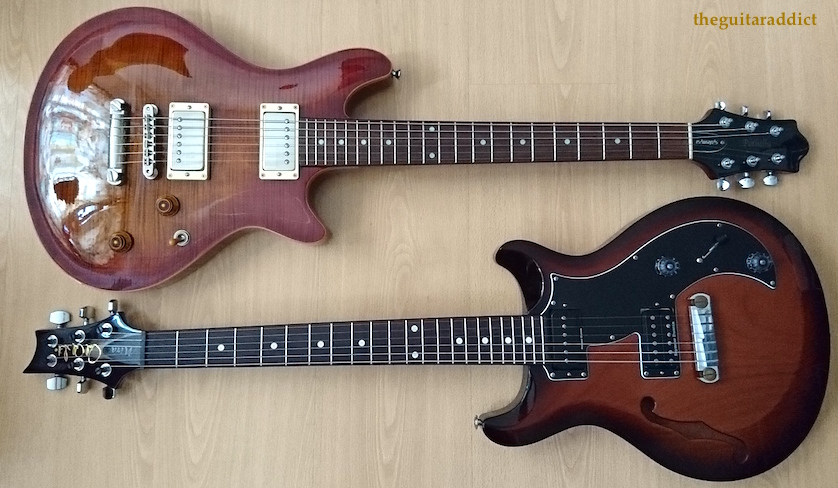
The Potbelly is LP-ish in looks but not in feel (slimmer, flatter neck profile here but not the shred type). The Duncan 59s in there are ace; awesome cleans & lots of beef for high gain stuff. The Mira has the JB in the bridge for its cutting tone & the P-Rails in the neck to keep things smooth on some days. Both are adept to my quirks, fast enough for shred stuff, smooth enough for legato works & angry enough for days when black metal is the only rewarding genre to play.

If both could satisfy the same needs, is it not logical to keep only one? No.

It's down to playing comfort & feel. I could not sustain good riffing on the Potbelly without lethargy setting in & inducing mistakes. The Mira, due to its bevelled body edges, sustains a comfortable elbow placement for the picking hand & it drives me on for extended playing. I am more comfortable playing legato stuff with the Potbelly due to the narrower neck profile. The wider Mira neck checks on my sloppiness; it encourages precision playing & accuracy. So there you go, having more than one will always keep my playing in perspective. 

Sunday, January 21, 2018

Hard tails


Spent the Sunday playing my PRSes, the Mira in the morning...


... the SC250 to close the day. Both guitars were given a fresh set of strings before playing.

I'm not too fond of finished necks so the real reason why I played them today was because I like to hear the Seymour Duncan pickups in action:
  • Mira: JB/ P-Rails
  • SC250: Pegasus/ P-Rails
Mira's partial hollow body dampened some brightness from the JB so it has a strong bottom end response for heavy music, no problems there. The P-Rails in its full humbucking mode sound very wooly in the neck but unlike a Gibson humbucker, there's still clarity in the mix. 

The SC250 on the other hand was pretty much dictated by the Pegasus. On a personal note, it's a prog-esque pickup for that rock-hippie type of tone very prevalent in the 70s but with a strong distortion presence. Technical geeks would love this pickup for its ability to manifest individual notes very well.

After a re-set up following the re-string & thorough cleaning I came to the realization that I could not get a super low, super shredding action simply due to the bridge type of both instruments Yes, a low action was possible but nothing Ibanez-like. It's a different playing experience but nothing hopeless & struggling when fast playing is concerned. Even for Gibson guitars, hard tail bridges are just not cut out for low action settings. They have this fixed height which was compounded by the top mount nature. We can only go so deep/ low & that's it. But I'm rather sick of this sunburst-type finish- no more for me.

Here's wishing you a good week ahead. Remember to embrace difference but ditch it once it makes you feel stupid. 😁

Monday, July 25, 2016

EVH & friends


Last weekend's preoccupation- EVH 5150III LBX. I guess I have not heard it in action enough. The Jackson here is equipped with A Seymour Duncan Sentient in the neck. I've come to believe that this neck pickup is a great complement to all things high gain in terms of tone. Not referring to cleans, of course. If you wish for something that speaks when extra drive is served, this pickup will serve you well.


My Yamaha Pacifica here is a focus tool. I'd play this one to enhance some concentration when it comes to technicalities but this guitar with this pickup (Duncan's P-Rails) sounds impressive with high gain, angry amps in its full glory & then some split coil performance- mind the hum, of course. 

Monday, March 7, 2016

Yamaha: Pacifica 510V


When Rich Lasner, the proverbial Ibanez RG designer switched camps in the late 1980s, he went to Yamaha. Lasner, together with Leo Knapp, prototyped the Pacifica models which went into regular production in the 1990s. Michael Lee Firkins & Bill Leverty were esteemed Pacifica endorsers & we know what these chaps could do. The Pacifica glory took a tremendous dip along the way, at one point in time, only the 112 version was in production. Everything else was removed from the catalogs. Maybe the economy at that point in time dictated the manufacturing of motor engines more than instruments & who would want a Pacifica anyway, yes?

Construction/ fit/ finish
The 510V you see here is part of the new wave of Pacificas in the market today. This one debuted in 2011, made in Indonesia. The '5' you see there is a reference to its tier, compared to a 112, the 510 sits way above the order featuring some of the best production standards & features you get for the asking price. The 510 has a very synthetic finish at the neck due to its intense lacquering. However, the appointments & details of the 510V neck has to be one of the best I've come across when it comes to standard production models. Particularly inviting is the fret edges which were well levelled & the nut slots manifested no choking. The 510V body is a simple alder, a very balanced feel together with the neck. I enjoyed playing it both sitting down & strapped on. All hardware here were well fixed less one string retainer which was misaligned during test time; nothing a screw driver couldn't fix. A no-frills yamaha with lots of good QC on board- what's there not to like in this department?


Playbility/ tone
The finished neck there is a little tricky when one has a sweaty palm but the feel remains very inviting. The profile is an interesting C with enough depth for blues bending moments. The action right out of the box was low-profile but our dear single coil loving brothers might set it up for a little more twang, action-wise. The immediate benefit of a single pickup guitar is that acres of space at the picking area so all forms of right hand techniques will benefit from this vacancy. If you are at home with a shred-type guitar of another brand, this one won't be any different.

Coming to that solitary Seymour Duncan P-Rails in the bridge position- it's simply an awesome highlight with enough dynamics to adapt to various music genres- rock, blues, metal to name a few. This pickup is one of my favourite because it has a flat response to begin with; that's right, equal servings of treble, midrange & bass. This is especially rewarding for clean applications involving the split coils. Since the selector is a 3-way version, it means you get three different tones to work with; full humbucking, P-90 type tone & a single coil voicing coming from that rail portion. The cleans are appealing considering they come from the bridge position which is quite devoid of that treble end roundness but the P-90 character has enough fatness to mimic this if one rolls back the tone control to taste. The humbucking mode is menacing enough with lots of distortion. In fact, you can pull off (no pun intended) some black metal with relative ease.

Conclusion
The Pacifica 510V is a versatile instrument put down by cynics who think the single pickup lacks tonal options. This is true if the manufacturer did not include a pickup selector to offer additional tones. Coupled with great playability, the 510V shouldn't be dismissed as an introvert's tool but it is very difficult to sway guitarists in general because they are mostly traditionalists who are not as contemporary in their instrument embrace (how else do you think the Les Paul & Strat survived all those years?). If you doubt Indonesian manufacturing standards, this would give some insights on quality .

Rating: 79%

Availability: Yamaha Beat Spot/ Sound Alchemy
List: $784 $769

Thursday, June 25, 2015

Singing Mira

I was at Beez's yesterday. I prefer a non-peak appointment time- more opportunities for gear talk while he's on the job.

I was there to get my pickups done (in my PRS S2 Mira):
  • Bridge: Seymour Duncan JB
  • Neck: Seymour Duncan P-Rails
As mentioned before, I'm not too sentimental about default pickups, if they are not singing my tune, they have to go & that was what happened to the Mira's 57/08 pickups. The default humbuckers were more than competent in making the Mira sing but I prefer a strong midrange response from the bridge which was deficient. The neck counterpart was wooly-sounding under much drive which wasn't my thing either. I want more clarity to supplement speedy passages. Done.

Tuesday, August 19, 2014

PRS: S2 SC250 Singlecut (owner's take Part 2)

The PRS S2 SC250 features a pair of #7 humbuckers. These are the preferred pickups for the instrument because they simply bring forth the lightweight goodness of the instrument. They are voiced to manifest both clarity & warmth. Despite the manufacturer's best efforts to recreate a pair of treasured PAF-type tones, these pickups are rather contemporary sounding.

As I spare no romantics for vintage voicings, a pair of Seymour Duncans made their way into my SC250. The objective was not to recreate any PAF-type tones because those would do me no good. So what you see here are the P-Rails in the neck & Pegasus in the bridge position. I prefer a P-90 type tone for such guitars in the neck but require the pickup to be hum-cancelling most of the time so the P-Rails did it for me. The Pegasus is one of the pickups in the Seymour Duncan catalog that I refer to as a 'next gen' model. It was conceived to manufacture contemporary tones with great distortion chemistry which are not heavy metal in nature. It's also a great pickup for prog-type tones. 

In the SC250, these pickups react well with the instrument's lightweight body. There has to be a consideration for weight if one is dealing with a PRS guitar. It's not as easy as buying one's preferred pickups & having them in a PRS because what works elsewhere might prove to be a folly in the PRS. It's all down to weight considerations. But I'm happy with the outcome. Somehow knowing what I am familiar with pays off in this aspect; there's some thinking of what should go into a guitar of a certain nature instead of leaving it to trial & error.

Thursday, November 29, 2012

Different vs differentiated

Two days ago, I spent time playing my Ibanez RGA32. I wanted something different in my hands but handling an Ibanez won't conjure much difference in feel since I own more than 30 Ibanez guitars whose necks are somewhat variations of the same profile. 

But playing the RGA32 was enjoyable & I left this guitar out (of its bag) for more playing time yesterday. It's down to the tone- I simply love my Duncans despite currently messing with more DiMarzios in some guitars. Duncan's Distortion has to be my 'safe tone' reference & that's what is in the bridge position of my RGA32. It just works for all things, em, distortion related (duh!). The P-Rails in the neck is what I really appreciate- some thick, single coil tones in split mode, thanks to the P-90 section of this pickup. In humbucking mode, it's nothing disappointing, crumbs of that single coil snap could still be heard from it & that's an important contribution to definition (clarity to the rest of us). 

Buying an Ibanez these days would mean that I'm investing in an acquainted feel so it's rather pointless buying more Ibanez without making them different & putting my preferred pickups in them is definitely an effort to make them different. Different as in entirely not the same? After plugging many guitars into the same amp & having the same settings for all of them, they actually sound similar; any difference here would be slight but it's that crucial dissimilarity that makes each one of my guitar differentiated.

Friday, April 15, 2011

Ibanez RGD321: Duncanized


Seymour Duncans in my Ibanez RGD321:
  • Neck: P-Rails
  • Bridge: Dimebucker
 I have expressed my acceptance of the Ibanez VK humbuckers which were default units in this guitar (& my ex-RGD320) but in this fixed bridge setting, they sound deeper than I'd like them to be (especially with the detuned nature of the RGD & its extended scale length). I've messed around with EQ settings & pickup height but that excess growl was ever-present. So the VKs made way for the above pair which added more clarity to the mix while retaining the rich bottom end. Wiring is courtesy of Beez (as always).

Saturday, June 12, 2010

Deactivated: Ibanez RGA32

I had my Ibanez RGA32 make-over going after the arrival of Duncan's Distortion Trembucker- thanks Janet (Davis GMC) for the acquisition assistance.

As announced in this entry's title, I had decided to remove the default active pickups (Ibanez's own LZ3 humbuckers) & replace them with passive Seymour Duncan units:

  • Neck: P-Rails (SPH-1)
  • Bridge: Distortion Trembucker (TB-6)
 Another reminder from me- if you wish to do like-wise, the bridge model should be an F-Spaced/ Trembucker model to comply with the Gibraltar Standard bridge string spacing, the above pic should be convincing enough.

The push-pull coil splitter switch was necessary to enjoy the P-Rail's P-90 & humbucking tones. The correct value pots were also installed following the guitar's non-active electronics application.

Finally, a peep in the control cavity- the Orange Drop cap is in there; rather obligatory for me these days. The re-wiring was expertly done by Master Beez & do note the long, black pickup wires which were left in tact. Beez does not snip off pickup wires excessively unless it interferes with other component placements. What's the plus point then? It means the pickup would be suitable for subsequent use in other guitars should there be any disntance related issues. The battery compartment is now not in use as no battery is required to power passive pickups.

Saturday, September 6, 2008

P-Rails!

My Duncan P-Rails is finally in! Waiting for a Trembucking Full Shred & these'll be in one of my Ibanez guitars...

Saturday, May 31, 2008

Seymour Duncan: P-Rails

Seymour Duncan, the name in pickup innovation, gives us the P-Rails. As depicted, the pickup is a regular sized humbucker, housing a rail type as well as the regular pickup pole-pieces. However, the discerning enthusiast would realize the pickup is actually a P-90 unit with an additional fused single coil at the top. The manufacturer promises 3 distinct tones from the single unit- a regular humbucker, a true single coil & of course, that fat P-90 tone.

ESP has already incorporated the P-Rails into one of the LTD Pot Belly models, as you can see, the neck version is also available. Already ordered mine...